


|
|
 In English
 Suomeksi
Benchmarks
Test system components:| CPU | Intel Pentium 4 (Prescott) 2.80GHz @ 3640 Mhz |
| Motherboard | ABIT AA8 Duramax |
| HDD | Seagate Barracuda 7200.7 200 GB SATA Seagate Barracuda 7200.7 80 GB PATA |
| GFX | PCIE X800XT |
| PSU | Cooler Master Real Power 450 |
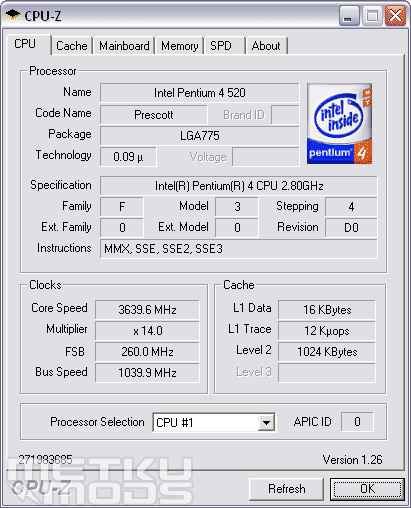
System info
Used operating system was Windows XP with SP2. Bios for motherboard was v17. Test were run multiple times to determine the correct values. Windows isn't always the best platform to run tests because there are many things happening behind the scenes but multiple loops usually give us a reasonable accurate value.
Both module kits were able to give stable operation with this ABIT AA8 motherboard at max. FSB of 260 MHz. That means that our "little" 2.8 GHz CPU were running at 3.64 GHz. Not a bad overclock but let us see what the results were.
Results
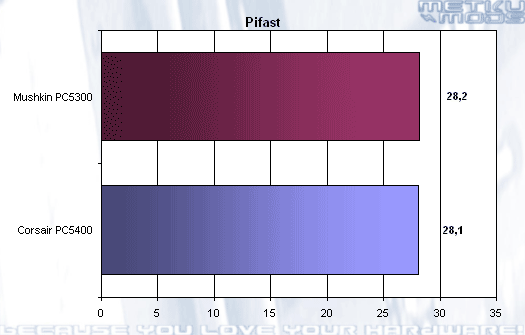
Pifast. Time in seconds. Lower time is better.
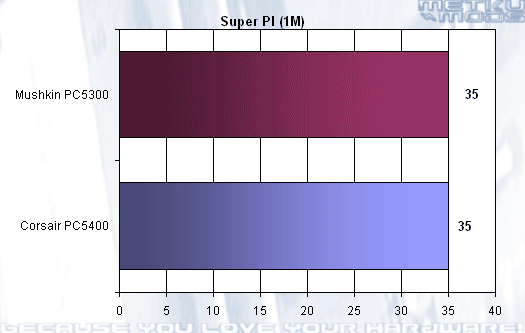
Super Pi (1M). Time in seconds. Lower time is better.
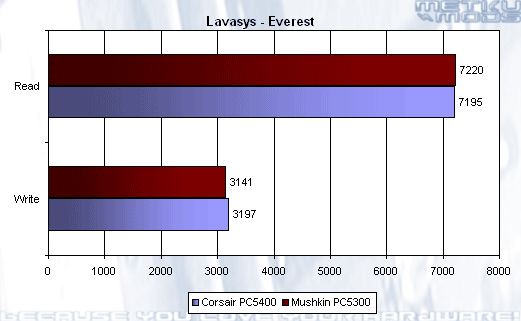
Everest. Transfer rate in megabytes. Higher value is better.
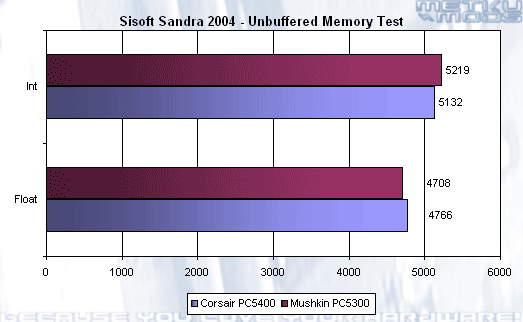
Sandra. Transfer rate in megabytes. Higher value is better.
What can I say... Memory modules that are rated for same speed and that are being run with the same overclocked speed give more or less the same values. It would have been very strange to see anything else happening. Situation is more or less the same when a site roundups ten X600 display adapters from different manufacturers who all use the same reference card from ATi to base their bundle upon. We were not lucky enough to get different overclocking results for the modules that would have given other kit bit more edge over the other. Again, are the products so much alike or does the motherboard limit the speed? Hard to say but there seem to be some indication that people with EE/Engineering sample CPUs are getting even better frequencies on some occasions. They have also tested different memory modules so it is hard to say what is the truth here.
 | Pages: 1 2 3 4 5 |  |
 Content in english!
 Sisältö suomeksi!